Parking guides
Sydney Airport Parking: Book by the Day or Reserve the Whole Month?
By ParkingShare Australia · · 6 min read
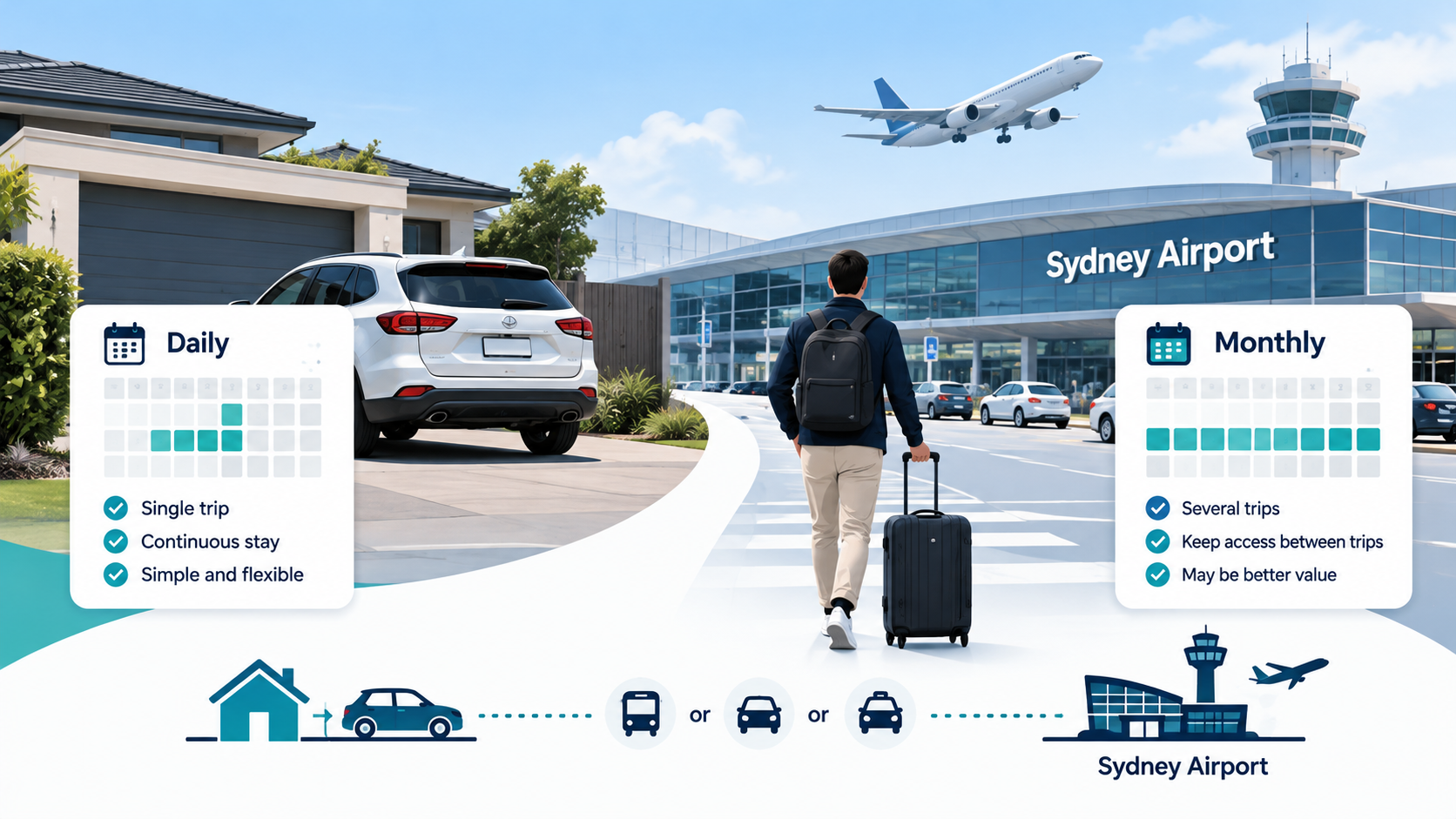
Searching for “parking Sydney Airport” can leave you comparing daily and monthly options that sound interchangeable. They are not necessarily selling the same thing: one might cover a single uninterrupted stay, while another might reserve access across several separate trips.
The useful question is not simply how often you fly. It is where your car will be between flights, and what access you need to retain.
ParkingShare is a peer-to-peer marketplace where people book private parking, storage and workspace from hosts with unused spaces. For airport parking, a private driveway or garage may suit your plans, but the booking period and access arrangement need to match your actual use.
Here is how to compare daily and monthly parking without assuming a monthly booking is automatically better value.
Start with the car’s calendar, not your flight calendar
A traveller can take several flights while their car stays in one place. Another can make several separate airport trips, taking the car home after each return. Those are different parking requirements.
Before browsing, write down:
- When the car will first enter the space.
- When it will leave after each trip.
- Whether it will return during the proposed booking period.
- Which dates are confirmed and which might change.
Include the time needed to collect luggage and travel from the terminal to the space. Your flight’s arrival time is not your parking departure time.
Identify which arrangement you actually need
| Your car’s pattern | What to compare |
|---|---|
| It stays parked throughout one trip | A daily-priced stay against any available longer-period offer |
| It goes home between several trips | Separate bookings against a monthly arrangement permitting repeated access |
| It stays near the airport between trips, but you sometimes use it | A continuous reservation with agreed exit and re-entry rights |
| Your later travel dates are uncertain | Confirmed bookings against the cost and conditions of reserving extra time |
This separates occupied time from reserved availability. A monthly booking may be useful for either, but you should establish which one the host is offering.
Step 1: Define what “daily” and “monthly” mean
Do not compare the labels until you understand the booking boundaries.
For a daily option, ask whether charging follows calendar dates, consecutive 24-hour periods or another stated method. A car arriving in the evening and leaving the following morning crosses a date boundary; check how that exact stay would be quoted.
For a monthly option, establish whether it means:
- A calendar month.
- A fixed period beginning on your arrival date.
- An ongoing arrangement with renewal or notice requirements.
Also confirm whether partial periods are available and how additional time is handled. Do not assume unused days are refundable or that an extension will be available.
Read the listing’s conditions alongside the applicable ParkingShare terms. If the proposed dates do not fit neatly into the advertised arrangement, ask for clarification before booking rather than interpreting the label yourself.
Step 2: Compare the same door-to-terminal journey
A parking quote is only one part of the decision. Compare each option using the same destination and transfer needs.
Sydney Airport identifies T1 as its international terminal and T2 and T3 as its domestic terminals. Confirm your terminal through your airline and the official Sydney Airport website before assessing a space’s location.
For each candidate, record:
- The parking quote for your exact dates and times.
- Any disclosed booking or access charges.
- Your planned transport between the space and the terminal.
- The number of transfers needed across all your trips.
- Any extra journey needed to collect or reposition the car.
Use Transport for NSW to investigate public transport routes, operating times and applicable fares. If you plan to use a taxi or rideshare, check the relevant provider rather than assuming a fixed transfer cost.
You can then browse Sydney parking spaces with a clearer comparison: not just location, but the complete journey each space requires.
Step 3: Put a value on the unused days
For a single trip, daily parking is a straightforward option to assess: obtain a quote covering the whole stay. For several trips, compare the total of separate bookings with the total monthly arrangement.
Use this simple structure:
Separate-booking total = all parking quotes + all required transfers + disclosed additional charges.
Monthly total = the monthly quote + all required transfers + disclosed additional charges.
Keep the transfer assumptions consistent. A monthly reservation does not remove the need to get between the car and the terminal on each trip.
If the monthly total is higher, the difference is what you would pay to retain the agreed access through the gaps. Decide whether that is worthwhile for your circumstances. If it is lower, still check that its access and cancellation conditions fit.
An empty reserved space is not automatically wasted money, but it should buy something you genuinely need. If your car is at home and the next trip is unconfirmed, reserving those dates may have little practical value.
Step 4: Confirm what happens when the car leaves
This is particularly important when comparing several daily bookings with one monthly reservation.
Ask the host:
- Can I enter and leave more than once during the booking?
- Will the same space remain reserved while my car is away?
- Are there access hours, gates or shared-driveway restrictions?
- Could another vehicle block my departure?
- Does entry depend on someone being present?
A monthly label alone does not answer these questions. Nor should you assume that leaving early ends the booking or creates a refund.
Keep the agreed arrangement in writing. ParkingShare’s frequently asked questions are a useful starting point for platform questions; clarify anything specific to the space before committing.
Step 5: Test one realistic change of plan
Rather than planning for every possible disruption, test the change most likely to affect you.
For a single holiday, that might be returning a day later. For repeated work trips, it might be cancelling one trip while keeping the others.
Ask what that change would mean for the booking, availability and total payment. A monthly arrangement might absorb a date change within its agreed period, but it will not necessarily cover time beyond its end. Separate bookings might limit your commitment, but later dates would still need to be available.
If the answer remains unclear, use ParkingShare’s contact page for help clarifying the platform process before booking.
Frequently asked questions
Is monthly parking always cheaper for a long trip?
No. Compare quotes for your exact stay, including transfers and disclosed charges. A monthly period may include time you do not need, and any extension beyond it needs separate consideration.
Can I use a monthly space for several airport trips?
Only if the agreed arrangement permits repeated entry and exit. Confirm that access remains available while your car is away, rather than assuming the monthly label guarantees this.
Should I book parking only until my flight lands?
Allow time to reach the car after landing. Consider baggage collection and your planned transfer, then check the host’s rules for collection outside the booked period.
What if I only know the dates of my first trip?
Compare booking that confirmed trip alone with reserving a longer period. Paying for uncertain dates may be worthwhile if the access is useful, but do not assume you can cancel or recover the unused portion.
The best choice matches the car’s movements, not just the traveller’s flights. Define the dates, confirm the access rights and compare complete journey costs before choosing daily or monthly parking.