Parking guides
Parking Near Me: Find a Local Space That Fits Your Actual Trip
By ParkingShare Australia · · 6 min read
Searching for “parking near me” is easy. Choosing a space that works for a medical appointment, shopping trip or evening class takes a little more thought. A nearby driveway might be on the wrong side of a busy road. A cheap bay might require you to leave before your appointment finishes.
When looking for affordable parking Australia-wide, start with the trip rather than the lowest advertised rate. The useful question is: which space gets me to the right entrance, at the right time, with an acceptable total cost?
This step-by-step method helps you compare local options without turning a short outing into a parking research project.
1. Search around the entrance, not just the address
Your destination’s street address is only a starting point. Before searching for parking, identify the entrance you actually need: the consulting rooms rather than the hospital’s main reception, the evening entrance to a college, or the collection point behind a shop.
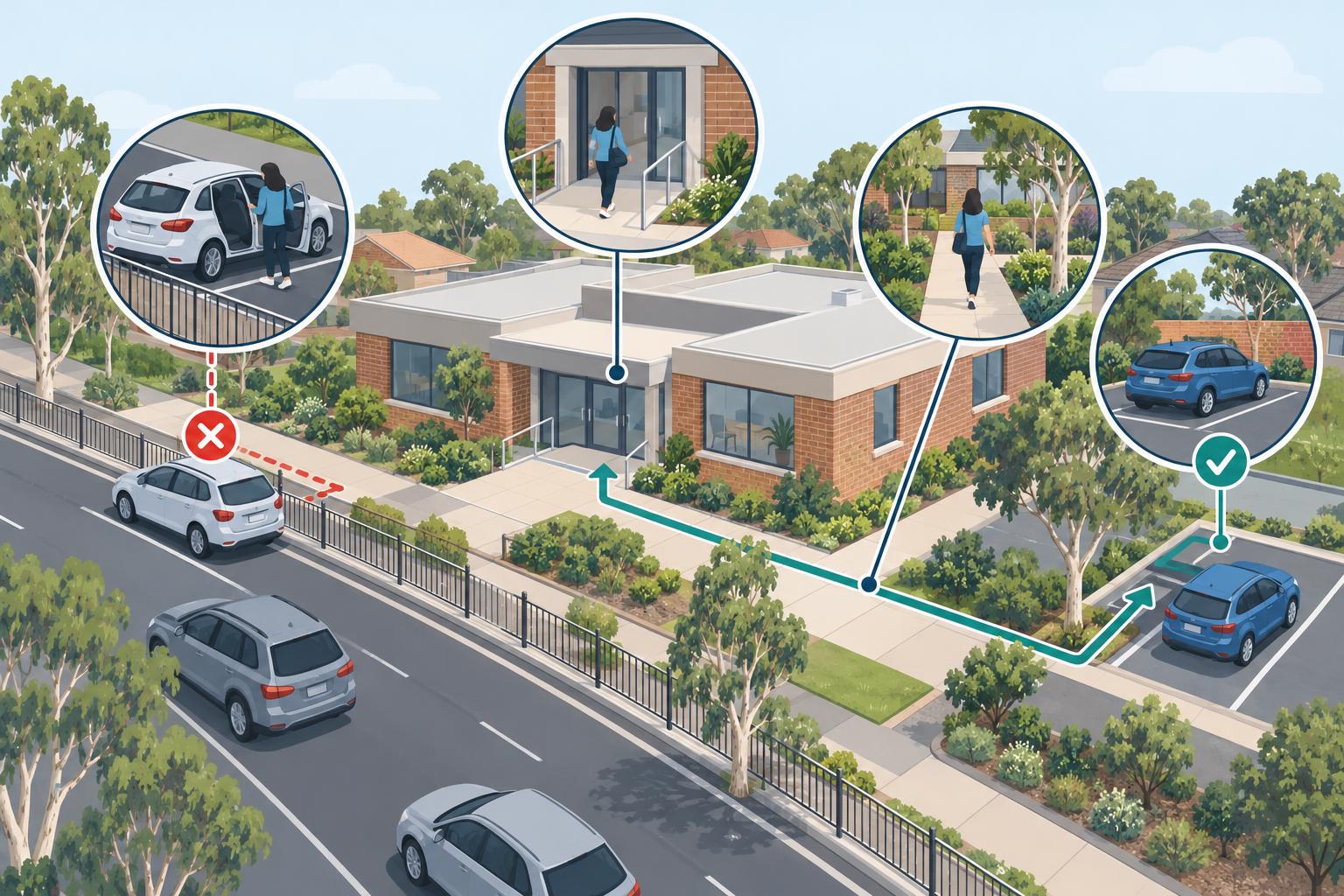
Then set your search area around the pedestrian journey from the parking space to that entrance.
Make a quick trip brief
Write down:
- Arrival deadline: when you need to be inside, not when you hope to park.
- Likely departure: including a buffer if the visit runs late.
- Walking requirements: step-free access, manageable gradients, shelter or somewhere to cross safely.
- Vehicle requirements: clearance, width, length and room to open doors.
- What you’re carrying: shopping, equipment, a pram or mobility aids.
For example, someone collecting a bulky order may value a straightforward loading route more than a shorter walk. Someone attending a late class may prioritise a route they feel comfortable using after dark.
2. Compare different types of local parking
Build a shortlist across several parking types rather than assuming one category is always cheapest or most convenient.
| Option | When to consider it | What to check |
|---|---|---|
| On-street bay | A brief visit with a flexible finish time | Signs, payment conditions and permitted duration |
| Council or public car park | A visit to a shopping strip or community facility | Operating hours, pedestrian exits and applicable charges |
| Commercial car park | A destination near an established parking facility | Entry conditions, clearance, closing time and total charge |
| Private driveway, garage or bay | A visit where reserving a particular local space suits your plans | Availability, vehicle fit, access arrangements and walking route |
| Destination parking | An appointment, collection or venue visit | Eligibility, opening hours and any validation conditions |
ParkingShare is a peer-to-peer marketplace where people book private parking, storage and workspace, and hosts list unused spaces. For this trip, focus on parking listings that match your location and required hours; don’t assume every driveway or garage will suit your vehicle.
For street and council parking, consult the relevant authority’s current information. The City of Melbourne and City of Sydney are useful starting points for their respective areas. Check the signs at the actual location before leaving your vehicle.
3. Compare the whole visit, not the headline rate
A displayed rate is only useful once you know what it covers. Compare each option for the same arrival and departure window.
Use a simple note on your phone:
Space: location and type
Parking window: arrival through to buffered departure
Total payable: amount shown for that window, including any disclosed fees
Walking route: entrance, crossings and access concerns
Restrictions: anything that could make the space unsuitable
Check whether the quoted amount applies to your intended day and time, and whether staying longer changes the cost. For a booking, read the applicable cancellation and change conditions before committing; ParkingShare’s terms are a starting point for understanding its conditions.
Keep cost and convenience separate initially. First eliminate spaces that cannot meet your essential requirements. Then compare the remaining options on price and the compromises you’re willing to make.
A lower charge is not much help if the permitted parking window ends halfway through your appointment.
4. Test the walk as carefully as the drive
Map distance alone doesn’t tell you whether a space is convenient. Review the actual pedestrian route, especially if a railway line, major road, large building or fenced site sits between the space and your destination.
Look for practical obstacles
Check:
- Is the pedestrian exit where you expect it to be?
- Does the route require stairs or a steep slope?
- Is there a suitable crossing where you need to cross the road?
- Will the destination entrance still be open when you arrive?
- Can you manage the return walk with whatever you’ll be carrying?
Treat map imagery as a planning aid, not confirmation of current conditions. If step-free access is essential, ask the destination and parking provider about the specific route rather than relying on a general description such as “close by”.
For several errands, consider parking once near the most demanding stop, then walking between the others. Compare that plan with moving the car each time; neither approach is automatically better.
5. Resolve access questions before booking
For a private space, turn vague descriptions into practical answers. “Fits most cars” is less useful than dimensions you can compare with your own vehicle.
Ask about:
- Usable space dimensions and any height restriction.
- Tight turns, slopes or narrow entrances.
- Whether another vehicle could block entry or exit.
- How access is arranged at your intended arrival time.
- Whether you can leave and return during the booked period.
- What to do if you are delayed.
Ask only what the listing hasn’t already answered. A concise message might be: “I need access during the evening and may finish late. Is departure possible throughout my booked window, and is the pedestrian exit step-free?”
Consult the frequently asked questions for general platform information. Confirm space-specific details before relying on them.
6. Save one realistic fallback
Even a carefully planned trip benefits from a backup. Identify one alternative that meets your essential requirements, rather than saving a long list of untested map pins.
Before leaving home:
- Save the location and access instructions somewhere you can retrieve easily.
- Check current traffic and allow time to park and walk.
- Note the backup option’s operating hours and conditions.
- Decide how you’ll handle a delay without assuming an extension is available.
If access is unclear when you arrive, stop somewhere lawful and safe before checking instructions or contacting the relevant person. Don’t occupy a neighbouring space simply because it appears empty.
Frequently asked questions
Is the closest parking space usually the best choice?
Not necessarily. Compare the route to your actual entrance, not just the distance between map pins. A slightly longer, simpler walk may suit you better than stairs, awkward crossings or a locked pedestrian exit.
How can I find affordable local parking without checking every listing?
Set your non-negotiables first: timing, vehicle fit and walking needs. Shortlist a few suitable options across different parking types, then compare the total cost for the same visit window.
What if I don’t know when my appointment will finish?
Choose a parking window with a realistic buffer and check what happens if you need longer. Don’t assume that a private booking, timed street bay or car park arrangement can be extended.
Can I use a private driveway for a short visit?
Look for a listing whose available booking period and access arrangements suit your visit. Confirm the intended use and hours rather than assuming every private space accepts short stays.
The best local parking search ends with a workable arrival plan: a suitable space, clear access instructions and a route to the right door. Price matters, but it becomes meaningful only after those basics are settled.