Parking guides
Daily or Monthly Parking for Brisbane Airport: Book for Your Routine
By ParkingShare Australia · · 6 min read

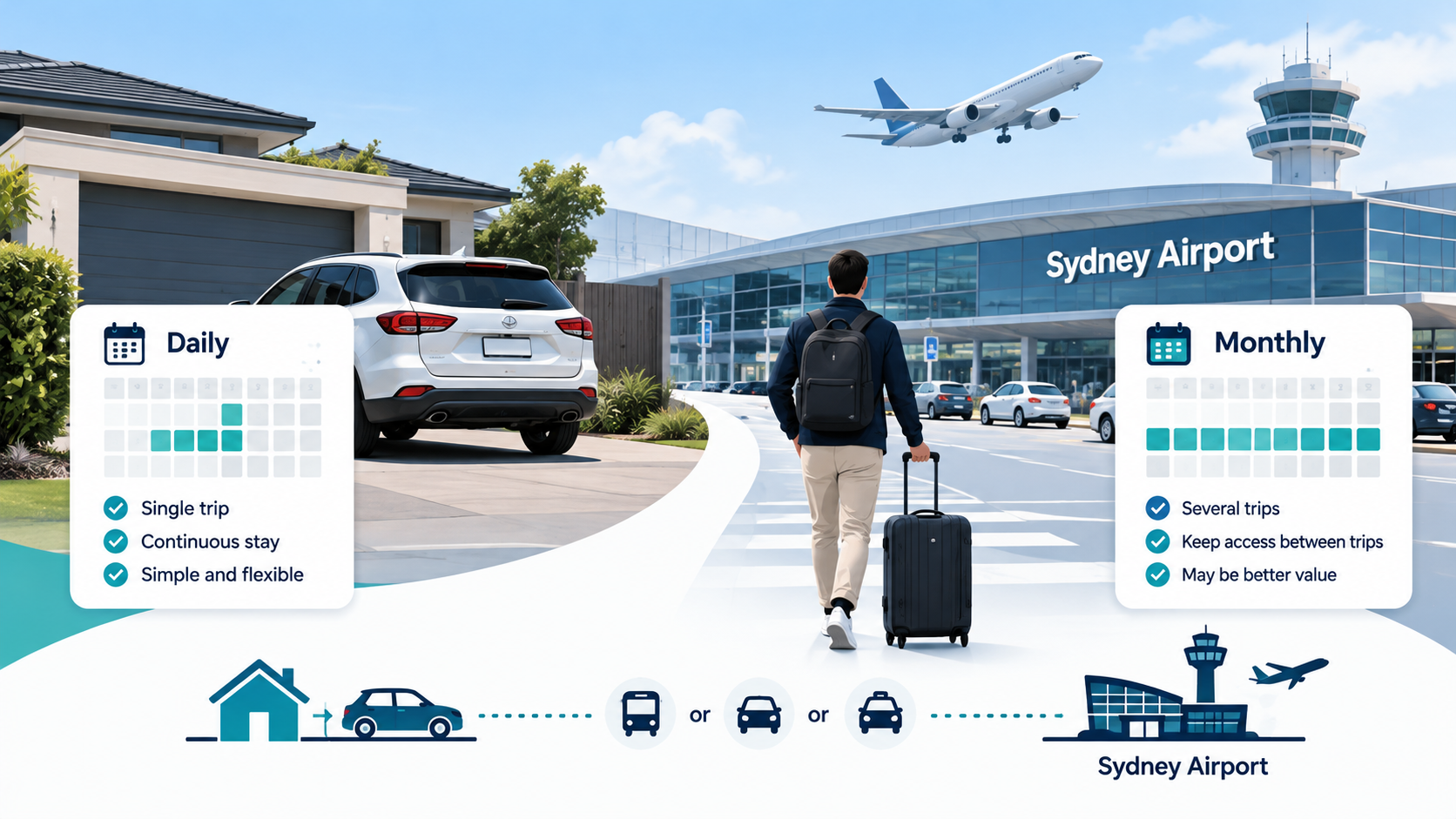
Daily versus monthly parking sounds like a question about price. For an airport traveller or worker, it is just as much a question about continuity: will your car stay put, come and go regularly, or need a space only on scattered dates?
When you search for “parking Brisbane Airport”, separate those patterns before comparing listings. A month-long booking is not automatically the right choice for a long trip, and daily parking is not automatically the simplest option for occasional use.
ParkingShare connects people with private spaces offered by hosts. The useful comparison is between booking arrangements that fit your routine—not merely two different rate labels.
Start with how the car will use the space
Think about the vehicle’s movements rather than the number of flights on your itinerary.
| Your parking pattern | What to investigate first | The important question |
|---|---|---|
| One trip, with the car left untouched | Daily parking covering the whole stay, alongside any suitable monthly option | Is the same space reserved continuously? |
| Several separate trips | Individual daily bookings versus a monthly arrangement | Can you leave and return throughout the booking? |
| Regular airport work shifts | Monthly parking with suitable access, or daily bookings matching your roster | Does access cover every shift you need? |
| Irregular work or uncertain travel | Daily bookings with clear change conditions | What happens if your dates move? |
These are starting points, not rules. A suitable arrangement depends on the actual listing, its availability and the conditions you agree to.
Step 1: Build a parking calendar, not a flight calendar
Write down when the car needs the space. Include arrival before departure and collection after your return, rather than copying flight times directly.
Then mark each date as one of three things:
- Occupied: the car will be parked there.
- Access needed: you will collect it, return it or visit it.
- Unused: you will not need the space that day.
This reveals the difference between a continuous stay and repeated use. A traveller leaving a car for several weeks needs uninterrupted permission to occupy the space. Someone working alternating shifts needs reliable entry and exit on specific days.
For terminal and transport information that informs your timing, consult the official Brisbane Airport website. Keep that information separate from the host’s parking conditions: booking a private space does not establish how you will reach the terminal.
Add the uncertainty you actually face
Note any unresolved roster dates, possible trip extensions or uncertain collection times. Do not quietly build your plan around an extension being available. Instead, compare what each arrangement says about changes before choosing it.
Step 2: Find out what “daily” and “monthly” mean
Treat each label as something to clarify, not a complete description of your booking.
For a daily option, establish whether the booking covers specified hours, a calendar day or another defined period. Check how an overnight stay crossing dates is quoted.
For a monthly option, ask whether it covers a calendar month, a defined block of dates or a recurring arrangement. Establish the start date, end date and any renewal or notice requirements.
Read the listing alongside the applicable ParkingShare terms. If something important is missing, seek clarification before committing.
Separate occupation from re-entry
These are different permissions:
- Continuous occupation: leaving the car in the space throughout the booking.
- Repeated access: driving out and returning during the booking.
- Reserved availability: keeping the space available while your car is elsewhere.
A frequent flyer might need all three. A traveller on one uninterrupted trip may mainly need the first. Ask explicitly rather than interpreting “monthly parking” as unlimited access.
Step 3: Compare complete arrangements
Browse Brisbane parking listings using your parking calendar as the brief. Compare daily and monthly options over the same dates and with the same access requirements.
Create a short worksheet for each candidate:
- Booking total: use the actual quote for your required dates, including any applicable fees shown.
- Access: record the permitted hours and whether repeated entry is allowed.
- Unused dates: identify any days you would pay for without using the space.
- Changes: record the cancellation, extension and early-finish conditions.
- Separate travel: include the transport you expect to use between the space and the airport.
- Administration: note whether you would need several bookings or one arrangement.
Unused days are not automatically wasted. You may value having a consistent space between trips. Equally, paying for continuity has little practical benefit if the access conditions do not suit you.
Avoid comparing a daily quote for your busiest week with a monthly quote for an entirely different period. That does not answer which arrangement fits your actual schedule.
Step 4: Test the arrangement against a changed month
Before booking, try three scenarios: a trip is cancelled, another trip is added, and your return moves later.
For each, ask: Could I still use this arrangement, and what would I need to change?
Daily bookings may suit dates that are scattered or unsettled, provided the change conditions work for you. A monthly arrangement may suit a stable routine, provided it gives you the continuity and access you need.
A mixed approach is also worth considering. For example, you might investigate a monthly space during a settled period of airport work, then use daily bookings once your roster becomes irregular. Do not assume you must choose one model permanently.
Step 5: Write a clear booking brief
Give the host a concise description of the arrangement you need. For example:
I need parking from [start date] to [end date]. My car will leave and return on [dates or days], usually around [times]. Can the space remain reserved while I’m away, and does the quoted booking allow those movements? Please also clarify the end date and any extension or renewal conditions.
For one continuous trip, replace the movement details with confirmation that the vehicle will remain parked throughout.
Use the ParkingShare FAQ for general questions. If you cannot establish how a proposed arrangement works, contact ParkingShare before proceeding rather than relying on an assumption.
Frequently asked questions
Is monthly parking always better for a long airport trip?
No. Compare the quote for your full stay with a monthly option covering the same dates. Continuous occupation, booking boundaries and change conditions matter alongside the total. A monthly label alone does not establish suitability.
Can I take my car out during a monthly booking?
Confirm this for the particular space. Ask about repeated entry, access hours and whether the space stays reserved while you are away. These details are especially important for airport workers and people taking several short trips.
What if my travel dates cross into another month?
Ask for a quote covering your exact arrival and collection dates. Establish whether the arrangement follows calendar months, a defined date range or another billing period. Do not assume a partial month will be charged proportionally.
Should I book monthly if my roster is not confirmed?
First test the booking against likely roster changes. Daily bookings may offer a closer match to confirmed shifts, while monthly parking may be useful once your needs settle. Choose based on the stated conditions, not an expectation that changes will be accommodated.
Choose the arrangement, not the label
The right daily or monthly option is the one that covers your real parking calendar, gives you the required access and has conditions you understand. Start with those three checks; then compare the complete quotes.