
Parking guides
Airport Parking in Four Cities: Plan the Trip from Driveway to Terminal
By ParkingShare Australia · · 6 min read
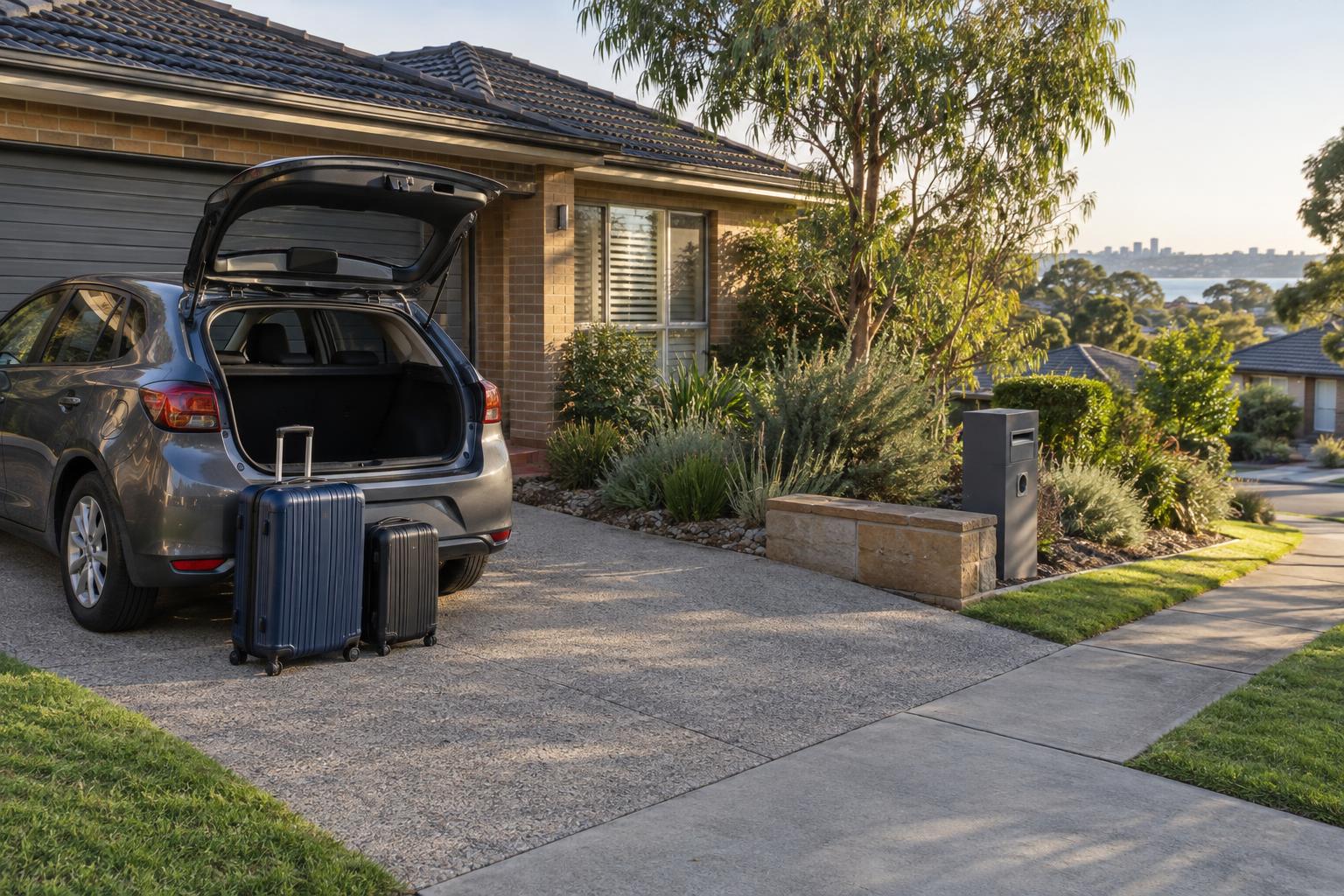
A parking space can look convenient on a map and still make departure day awkward. The missing detail is often the journey between the parked car and the correct terminal: who takes you, where they collect you, and what happens when you return late.
For Sydney, Melbourne, Brisbane and Perth airport parking, start with the whole journey rather than the parking location alone. This guide focuses on making private parking work around your flight, luggage and travelling companions—not simply finding somewhere to leave the car.
Step 1: Confirm the airport and terminal before searching
Use your flight booking to identify your departure airport and terminal, then check your return details separately. Do not assume both journeys use the same terminal. Recheck with your airline before travelling.
Sydney: make the terminal part of your search
Sydney Airport identifies T1 as its international terminal and T2 and T3 as its domestic terminals. Check current terminal and transfer information with Sydney Airport.
When reviewing private parking in Sydney, estimate the onward journey to your actual terminal—not just to an airport map pin. A location that suits one terminal may involve a different route to another.
Ask where your onward driver can collect you without blocking the host’s driveway. If your return terminal differs, plan that collection point separately.
Melbourne: check the terminal-level drop-off
Melbourne Airport has four terminals, T1 to T4. Use Melbourne Airport for current terminal maps and ground transport guidance.
For private parking in Melbourne, assess both the drive to the space and the transfer from there. Confirm the terminal with your airline and give that detail to whoever is taking you onward.
A transfer plan should finish at an appropriate drop-off point, not simply at the airport boundary. Consider how far you can comfortably move your luggage after leaving the vehicle.
Brisbane: plan domestic and international journeys separately
Brisbane Airport has separate Domestic and International terminals. Check Brisbane Airport for terminal access and current transport information.
When considering private parking in Brisbane, test the transfer plan against your flight time. A transport option that looks practical during the day still needs checking for an early departure or late arrival.
Write down a backup way to reach the terminal. That might be another transport provider or a lift from someone you know; do not assume a host offers airport transfers.
Perth: identify the terminal precinct first
Perth Airport groups its terminals into the T1/T2 and T3/T4 precincts. Confirm your terminal and current access arrangements through Perth Airport.
Before booking private parking in Perth, compare the onward route to the relevant precinct. Treat “near Perth Airport” as a starting point, not enough information to make a decision.
Check the return flight as carefully as the outbound flight. Your car retrieval plan needs to work from wherever you actually arrive.
Step 2: Work backwards from your airline’s arrival advice
Your parking booking should support your flight schedule, rather than determine it.
Build your departure plan in this order:
- Check your airline’s guidance. Establish when you should reach the terminal for your particular flight.
- Allow for the terminal approach. Include unloading and moving from the drop-off point to check-in.
- Estimate the onward transfer. Use your intended travel time, not only a quiet-period map estimate.
- Include collection time. Allow for your lift or transport to arrive after you park.
- Allow time at the space. You need to locate it, park correctly, unload and secure the vehicle.
- Add contingency. Choose a buffer that reflects how much uncertainty you can tolerate.
For the return, work forwards from landing. Include disembarking, any baggage collection and arrival formalities, transport back to the space, and loading your car. Scheduled landing time is not a sensible car collection time.
Step 3: Check whether the space suits your vehicle and luggage
ParkingShare is a peer-to-peer marketplace where hosts list unused parking and other spaces. Assess the individual listing rather than assuming it works like a staffed airport car park.
Before booking, seek clear answers to these practical questions:
- Will the car fit? Check usable dimensions, entry width and any height restriction, including roof racks or a roof box.
- Can everyone get out? Leave room for doors, a pram, mobility equipment and unloading bags.
- Is access independent? Ask whether another vehicle could block yours or whether someone must open a gate.
- Who keeps the keys? Confirm whether you retain them and whether anyone expects to move the vehicle.
- What are the access hours? Check both your planned arrival and the possibility of a delayed return.
If you need step-free access, ask about the complete route from the parked vehicle to the collection point. A space description alone may not answer that question.
Step 4: Compare the complete journey, not just the parking charge
Use the same booking dates and times when comparing options. Build a simple total:
Parking charge + outbound transfer + return transfer + any applicable extras.
Then assess the non-price factors: waiting, luggage handling, access restrictions and the number of separate arrangements you need to coordinate.
For a family, confirm how everyone and their bags will travel together. If child restraints are needed, check arrangements directly with the transport provider and consult the relevant state road authority for current requirements.
Private parking may suit someone with a dependable lift particularly well. If you need a transfer included, only rely on one when it is explicitly offered and its arrangements are clear.
Step 5: Agree on the late-return plan
Resolve the awkward scenario before departure: your flight arrives after the booked parking period or outside the host’s access hours.
Ask how to request an extension, what charges or conditions would apply, and what happens if the space is already needed by someone else. Do not assume extra time will be available.
Save the address, access instructions, agreed collection arrangements and relevant contact details somewhere you can retrieve them easily. Keep a backup copy in case mobile data is unavailable.
If insurance protection matters to your decision, ask your vehicle insurer about your circumstances. Do not infer insurance cover, security arrangements or responsibility for damage from a space being listed on a marketplace.
Frequently asked questions
Does private airport parking include a shuttle?
Do not assume so. Treat parking and terminal transport as separate arrangements unless the listing explicitly includes a transfer. Confirm operating hours, luggage capacity and the return collection process before relying on it.
How long should I book the space after my flight lands?
Allow for the full journey back to your car, not just landing. Consider baggage, arrival formalities, transport waiting time and possible delays. Choose a realistic collection time and clarify extension arrangements in advance.
Can I walk from a nearby private space to the airport?
Only plan to walk after checking that a suitable pedestrian route exists. Map distance alone does not establish footpath access. Consult the airport’s current access information and consider luggage, weather, lighting and your mobility needs.
What if my terminal changes after I book?
Recalculate both the transfer route and timing. Check whether your transport arrangement still works and whether your parking access times need changing. Contact the host promptly if the revised journey affects your booking.
The best-fitting space is one that supports the complete trip: a clear arrival, a workable terminal transfer and a realistic return plan.