General
Safety & Legal Checklist for Renting Out Your Private Garage or Space
By ParkingShare Australia · · 12 min read
Safety & Legal Checklist for Renting Out Your Private Garage or Space
Renting out your private garage, driveway or parking space can be a practical way to earn extra income in Australia. However, before making your space available to other drivers, it is important to understand your legal responsibilities, insurance arrangements and safety obligations.
Whether you own a house in Brisbane, an apartment in Sydney or a commercial property in Melbourne, the rules that apply to your parking space may depend on your property type, state or territory, local council requirements and existing agreements.
This guide provides a practical safety and legal checklist to help parking space owners prepare before renting out their unused space.
Important: This article provides general information, not legal or insurance advice. Requirements vary across Australia. Confirm the rules that apply to your particular property before accepting a booking.
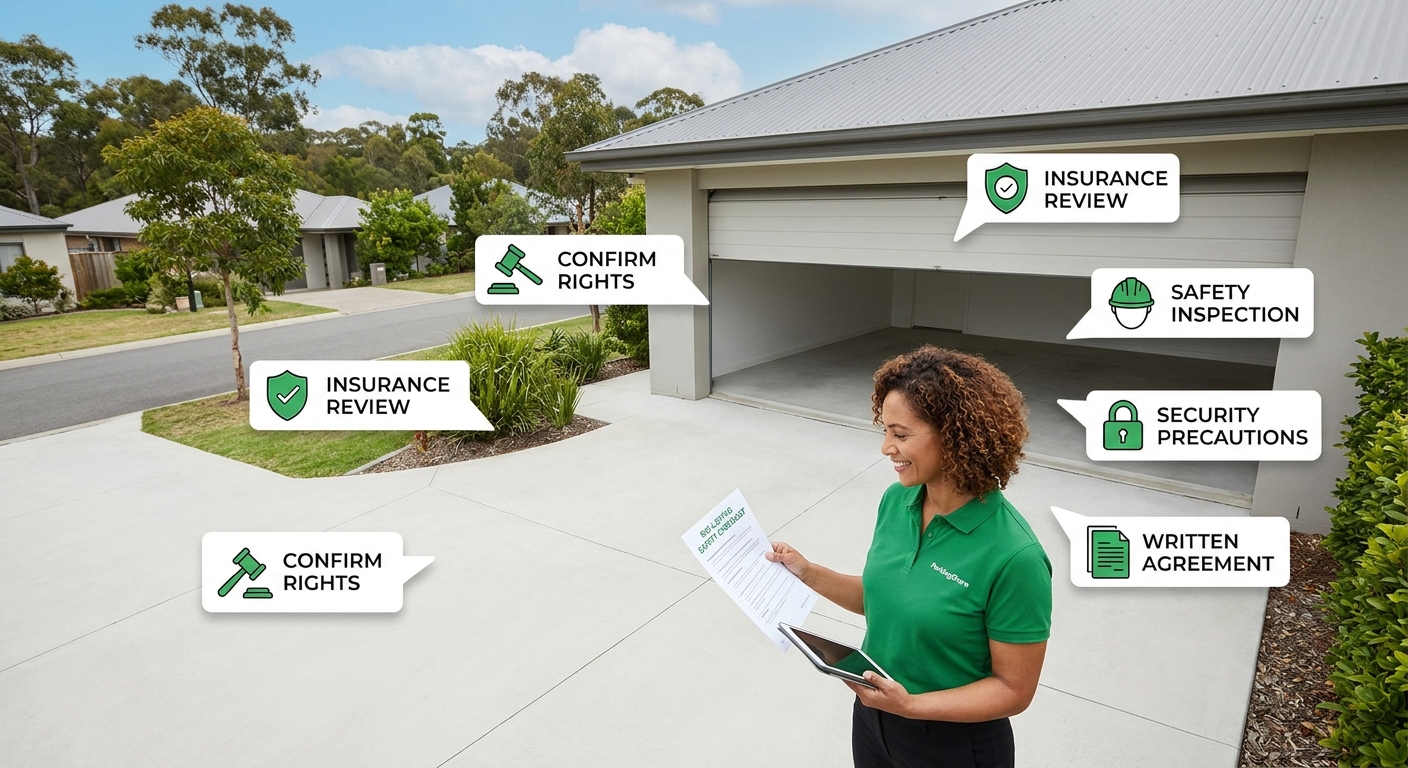
1. Confirm That You Have the Right to Rent Out Your Parking Space
Before listing your garage or driveway, establish whether you are legally entitled to offer it to another person.
If You Own a House
If you own a standalone house with a private driveway or garage, you may be able to rent out an unused parking space. However, ownership alone does not automatically resolve every issue.
Check whether any applicable planning conditions, local council requirements, property restrictions or insurance conditions affect the proposed arrangement.
If the space is shared with another owner or forms part of a jointly owned property, confirm that you have the necessary agreement.
If You Own an Apartment or Strata Property
Apartment parking can involve additional rules.
Before listing your space, check:
- Whether the parking bay forms part of your individual property lot or is common property
- Whether you have exclusive use rights over the space
- Whether strata by-laws or other applicable rules restrict third-party parking
- Whether access arrangements or security rules affect outside users
In New South Wales, strata by-laws can regulate parking and the use of common property. The applicable rules depend on the particular strata scheme.
Read the relevant by-laws and obtain professional advice if you are uncertain about your rights.
If You Rent Your Home
If you are a tenant rather than the property owner, do not assume that you can sublet your driveway, garage or allocated parking space.
Review your tenancy agreement and obtain the landlord's written permission where required. Also check any applicable strata or body corporate rules.
Offering a space without the necessary permission could breach your tenancy agreement.
2. Check Your Home Insurance and Liability Cover
Insurance is one of the most important considerations when renting out a private parking space.
A standard home or contents insurance policy may not automatically cover every incident connected with a paid parking arrangement. The position depends on the policy wording and the circumstances of the incident.
Before accepting your first booking, contact your insurer and explain exactly how you intend to use the space.
Ask questions such as:
- Does my policy cover a driveway or garage rented to third-party drivers?
- Could receiving parking income affect my existing home insurance?
- Is public liability cover included, and what exclusions apply?
- Am I covered if a driver is injured while accessing the space?
- What happens if a vehicle damages my garage door, fence or property?
- Are there special requirements for regular or commercial use?
Keep a written record of your insurer's response.
Do not assume that the insurance offered by a parking marketplace replaces your own property or liability insurance. Check the current terms of both policies and establish which risks are covered.
For strata properties, also check what the building's strata insurance covers and what remains your responsibility as an individual owner.
3. Make Sure the Parking Space Is Safe
A parking space should be reasonably safe and suitable for the intended vehicle and parking arrangement.
Before listing your space, carry out a basic inspection.
Safety Inspection Checklist
- The parking surface is stable and suitable for the intended vehicle.
- There are no obvious trip hazards, dangerous obstructions or exposed hazards.
- The driveway and entry point are reasonably clear.
- Lighting is adequate for the expected arrival and departure times.
- Gates and garage doors operate safely.
- The space is large enough for the vehicles you intend to accommodate.
- Any height, width or weight restrictions are clearly stated.
- Water drainage and surface conditions do not create obvious hazards.
- Emergency access and pedestrian pathways remain clear.
- Any relevant building, fire safety or access requirements are satisfied.
This checklist is a practical starting point, not a substitute for a professional inspection where one is required.
If you identify a significant hazard, resolve it before making the space available.
4. Protect Your Home, Garage and Personal Belongings
Allowing another person to access your property requires sensible security precautions.
If you are renting out a garage, decide whether the driver will have access only to the parking area or also to any shared entrance or gate.
Consider the following measures:
- Keep personal documents, valuables and private belongings out of the parking area.
- Separate the parking space from private areas of your home where practical.
- Avoid sharing unnecessary personal information.
- Use secure access arrangements and change access codes when appropriate.
- Explain which areas the driver may and may not enter.
- Do not provide access to internal rooms or storage areas unless this is expressly intended and appropriate.
- Keep a record of agreed access instructions and any access devices provided.
If the driver only needs a driveway, do not give them unnecessary access to your garage or house.
Clear boundaries can reduce misunderstandings and help protect both parties.
5. Set Clear Parking Terms in Writing
A written agreement can help prevent disputes by setting out exactly what the host and driver have agreed.
Even when using an online parking marketplace, read the applicable terms and determine whether a separate agreement is necessary for your arrangement.
Your parking terms should ideally address the following matters.
Essential Terms to Consider
The parking space: Identify the exact bay, driveway or garage being offered.
Permitted use: Specify whether the space is for parking a vehicle only. Do not assume that an arrangement for parking also permits storage, vehicle repairs or overnight accommodation.
Parking times: State the permitted arrival and departure times, including any access restrictions.
Price and payment: Confirm the price, payment schedule and any applicable fees.
Duration: Specify whether the arrangement is for a single booking, recurring use or a longer-term period.
Access arrangements: Explain how the driver enters and exits the property and whether a key, remote or access code is required.
Vehicle restrictions: Identify any limitations involving vehicle dimensions, vehicle type or other relevant conditions.
Cancellation and termination: Explain how either party can cancel or end the arrangement, subject to applicable law and the marketplace's terms.
Damage and incidents: Set out how incidents should be reported and how the parties will handle damage claims.
Dispute resolution: Establish a clear process for raising concerns and attempting to resolve disagreements.
For ongoing or higher-value arrangements, consider asking a lawyer to review the agreement. A written document is helpful, but it cannot automatically exclude legal responsibilities that apply under Australian law.
6. Check Local Council and Planning Requirements
Do not assume that every parking arrangement is subject to the same rules throughout Australia.
Requirements can vary depending on the location, the property, the nature of the activity and whether the arrangement changes how the land is used.
Before listing a space, consider whether you need to check:
- Local council planning or land-use requirements
- Existing development approval conditions
- Access to the property from a public road
- Restrictions affecting commercial activity at a residential property
- Rules concerning signs, gates or physical alterations
- Fire safety or building requirements, where relevant
A straightforward arrangement involving an existing residential driveway may raise different issues from operating a larger parking area as a commercial business.
If you plan to offer multiple spaces, operate regular commercial parking or make physical changes to the property, contact your local council to confirm what applies.
7. Understand Strata and Body Corporate Rules
If your parking space is in an apartment building, townhouse complex or another community-title development, check the applicable rules before allowing non-residents to use it.
In Australia, strata and body corporate arrangements differ between states and territories.
Rules may address:
- The use of allocated parking bays
- Visitor parking
- Access to common property
- Security passes and entry gates
- Noise and vehicle movements
- Use of shared driveways
- Restrictions on access by non-residents
In Queensland, body corporate by-laws may regulate the use of lots and common property. In New South Wales, strata by-laws can also affect parking and access.
Do not assume that permission to park in a space automatically grants permission to use shared facilities or provide access to the wider building.
If you are unsure whether your space can be rented to an outside driver, contact your strata or body corporate manager and obtain clarification before listing it.
8. Keep Accurate Records of Income and Expenses
If you earn money from renting out a parking space, keep records of the income you receive and relevant expenses.
Depending on your circumstances, the income may have tax implications. The treatment can depend on factors such as your ownership arrangements, the nature of the activity and your overall tax position.
Useful records may include:
- Dates and amounts of parking payments
- Marketplace fees and other related costs
- Receipts for repairs or maintenance
- Insurance correspondence
- Written agreements and booking confirmations
- Records of damage or other incidents
Do not assume that small amounts of parking income are automatically tax-free.
For information relevant to your situation, consult the Australian Taxation Office or a registered tax professional.
Official resource: https://www.ato.gov.au/
9. What Should You Do if a Driver Damages Your Property?
Even with good preparation, an incident can occur.
If a driver damages your garage door, fence, driveway or another part of your property, take practical steps to document what happened.
- Ensure that everyone is safe and address any immediate danger.
- Photograph the damage and the surrounding area.
- Record the date, time and details of the incident.
- Keep relevant messages, booking details and payment records.
- Contact the driver through the agreed communication channel.
- Notify your insurer if the incident may be covered.
- Follow the applicable marketplace process for reporting the incident.
- Obtain repair estimates and retain invoices where appropriate.
Avoid promising that a claim will be paid before the relevant insurer or responsible party has assessed the circumstances.
If the matter cannot be resolved, you may need independent legal advice about your options.
10. Parking Host Safety Checklist Before Your First Booking
Use this final checklist before making your space available.
{@body const checklist = [{section:"Permission and legal requirements",items:["I have confirmed my right to offer the parking space.","I have checked my tenancy agreement, strata by-laws or body corporate rules where relevant.","I have checked any applicable council or planning requirements."]},{section:"Insurance and liability",items:["I have discussed the arrangement with my insurer.","I understand the relevant policy exclusions and liability arrangements.","I know how to report an accident or property damage."]},{section:"Space and security",items:["The space is suitable for the intended vehicle.","I have addressed obvious safety hazards.","Access instructions and boundaries are clear.","Personal belongings and private areas are appropriately secured."]},{section:"Booking and records",items:["The price, dates and permitted use are clear.","Cancellation and access conditions are documented.","I know how to contact the driver if a problem occurs.","I will keep records of payments, expenses and incidents."]}]}
{@body const [checkedItems,setCheckedItems] = DIL.useState([])}
Pre-listing checklist
{checkedItems.length}/{checklist.reduce((n,s)=>n+s.items.length,0)} complete
<box background="#16845B" height="6px" radius="full" width={${checkedItems.length/checklist.reduce((n,s)=>n+s.items.length,0)*100}%} />
{#each checklist as section,si}
{section.section}
{#each section.items as item,ii}
<checkbox key={item} checked={checkedItems.includes(item)} onChange={v=>setCheckedItems(prev=>v?[...prev,item]:prev.filter(x=>x!==item))}>{item}
{/each}
{#if si<checklist.length-1}{/if}
{/each}
<button block variant="outline" onClick={()=>setCheckedItems([])}>Reset checklist
<button block onClick={()=>GenUI.copy(checklist.map(s=>s.section+"\n"+s.items.map(i=>(checkedItems.includes(i)?"[x] ":"[ ] ")+i).join("\n")).join("\n\n"))}> Copy checklist
Frequently Asked Questions
Can I legally rent out my driveway in Australia?
It may be possible, but the answer depends on your ownership or tenancy arrangements, the property's restrictions and any relevant local requirements. Confirm that you have the right to offer the space before accepting payment.
Do I need permission to rent out my apartment parking space?
You may need to check your strata or body corporate rules, the status of the parking space and any relevant ownership or lease conditions. Requirements vary by property and state or territory.
Does my home insurance cover a rented parking space?
Not necessarily. Coverage depends on your policy wording and circumstances. Tell your insurer how you intend to use the space and obtain clarification before accepting bookings.
Should I have a written agreement?
A written agreement is strongly advisable, particularly for recurring or longer-term arrangements. It can clarify the permitted use, access, price, duration, cancellation arrangements and how incidents will be handled.
Can I rent out my garage for storage as well as parking?
That depends on your rights over the space, the agreed use, applicable rules and insurance conditions. If you intend to allow storage, define what can be stored and who is responsible for it. Do not assume that a parking arrangement permits other uses.
Do I need to declare parking income?
Parking income may have tax implications. Keep accurate records and consult the Australian Taxation Office or a registered tax professional about your circumstances.
Final Thoughts
Renting out an unused garage, driveway or private parking space can create an opportunity to earn extra income while helping local drivers find parking.
The key is to prepare properly before the first booking. Confirm your permissions, review insurance, check the safety of the space, establish clear terms and keep accurate records.
A well-prepared parking space is better for both hosts and drivers.
If you have an unused parking space, visit Parkingshare.com.au to explore parking-sharing opportunities and learn more about making your space available.
Disclaimer: This article is for general information only and is not legal, financial, tax or insurance advice. Laws and requirements vary by Australian state and territory, local council and property arrangement. Check the rules that apply to your circumstances and seek qualified professional advice when necessary.