
Parking Tips
Monthly Parking vs. Daily Commercial Rates: How Much Can You Save?
By ParkingShare Australia · · 12 min read
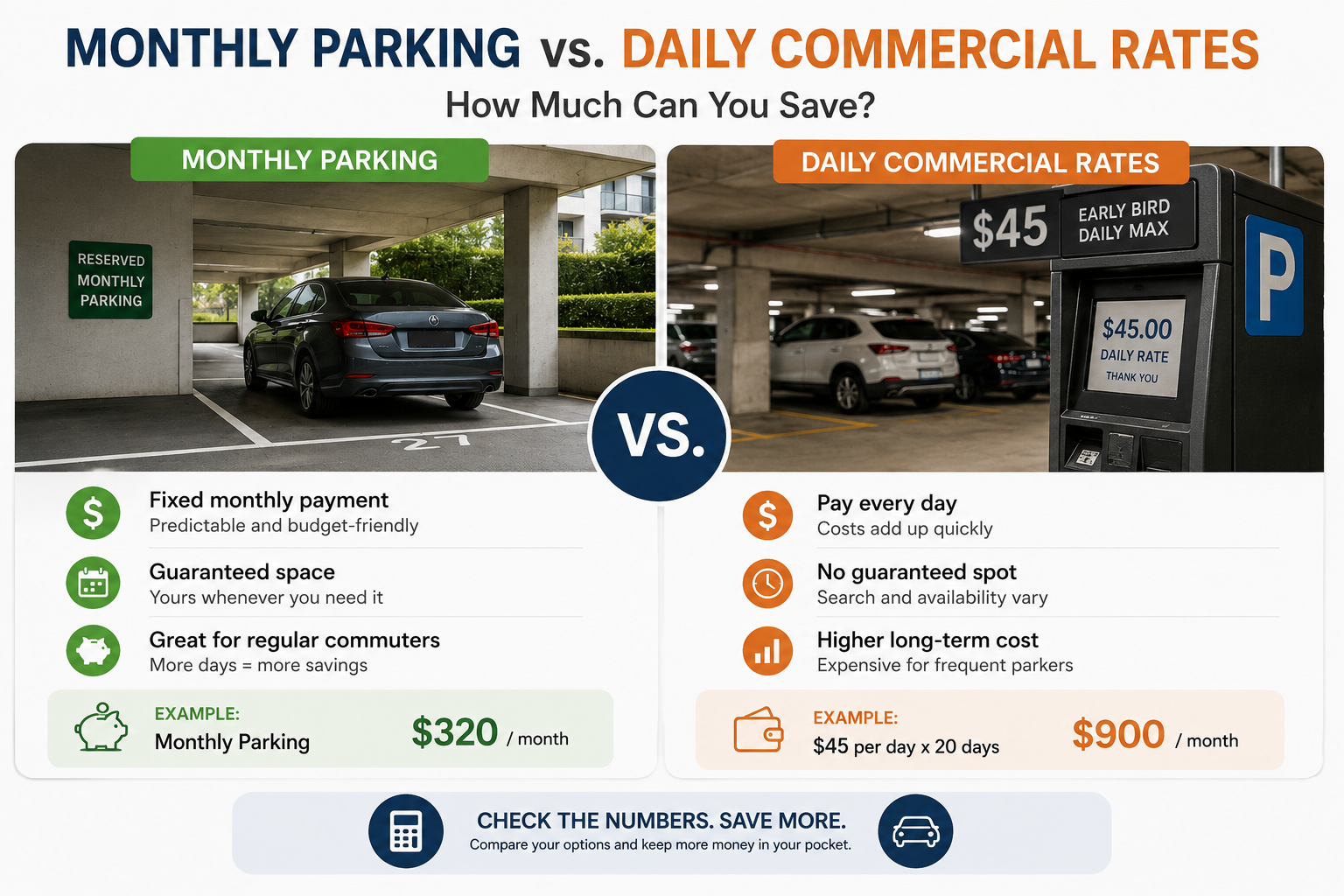
Monthly Parking vs. Daily Commercial Rates: How Much Can You Save?
If you drive to work regularly in an Australian city, parking could be one of your biggest recurring transport expenses.
Paying for parking one day at a time may seem convenient. You only pay when you need a space, and you don't have to commit to a monthly arrangement. But when you park several days a week, those daily payments can quickly add up.
Monthly parking offers a different approach: instead of paying a daily rate, you pay a set monthly fee for a parking arrangement that suits your needs.
So, which option is better value? And how much could you save by switching from daily commercial parking to monthly parking?
In this guide, we'll compare the costs, work through practical examples and explain how to find a parking option that fits your budget in Sydney, Melbourne, Brisbane, Perth and other Australian cities.
1. What Is the Difference Between Monthly and Daily Parking?
Before comparing prices, it's important to understand how the two options work.
Daily Commercial Parking
Daily commercial parking is usually offered by professionally operated car parks in CBDs, shopping precincts, office districts and other busy locations.
You generally pay for each parking session or day you use the facility. Depending on the operator, you may have access to casual hourly rates, maximum daily rates, early-bird specials or online booking discounts.
Daily parking may be suitable if you:
- Visit the city occasionally
- Work from home several days a week
- Need parking for appointments or shopping
- Have an unpredictable schedule
- Don't want an ongoing parking commitment
The main disadvantage for regular commuters is that paying repeatedly can become expensive.
Monthly Parking
Monthly parking involves paying a recurring fee for an agreed parking arrangement, typically for a longer-term period.
Depending on the provider and the specific agreement, it may offer a reserved space, regular access or other conditions. Always check what is included before committing.
Monthly parking may suit you if you:
- Drive to work most weekdays
- Need a regular space near your office
- Park in the same area several times a week
- Want more predictable monthly expenses
- Prefer not to search for a new space every day
Monthly parking is not automatically cheaper for everyone. The best option depends on the daily rate, monthly fee, number of parking days and the access conditions.
2. How Much Does Daily Parking Cost Over a Month?
The easiest way to understand the cost of daily parking is to multiply the daily rate by the number of days you park.
For a typical weekday commuter, let's use 20 parking days per month as an example.
| Daily parking rate | 10 days per month | 20 days per month |
|---|---|---|
| $20 per day | $200 | $400 |
| $30 per day | $300 | $600 |
| $40 per day | $400 | $800 |
| $50 per day | $500 | $1,000 |
These figures are illustrative calculations, not quoted market prices. Actual rates vary by city, location, operator, booking conditions and time of day.
The key point is that even a seemingly manageable daily fee can become a substantial monthly expense when you park frequently.
For example, paying $40 per day for 20 days costs $800 per month, before any additional fees.
That makes it worthwhile to compare monthly parking and other alternatives.
3. Monthly Parking vs. Daily Parking: A Savings Example
Let's compare two hypothetical parking arrangements.
Suppose you currently pay $30 per day for commercial parking and park 20 weekdays each month.
Your daily parking cost would be:
$30 × 20 days = $600 per month
Now imagine you find a suitable monthly parking space for $300.
Your potential savings would be:
| Cost comparison | Amount |
|---|---|
| Daily parking: $30 × 20 days | $600 |
| Example monthly parking fee | $300 |
| Potential monthly savings | $300 |
| Potential annual savings over 12 months | $3,600 |
In this example, the monthly arrangement costs 50% less than paying the daily rate for 20 days.
However, these savings are hypothetical. They assume that the monthly space is available for your required dates, offers suitable access and has no additional costs that change the comparison.
Your actual savings will depend on the prices and conditions available in your area.
4. Use This Table to Estimate Your Potential Savings
The following examples show how the result changes when daily rates and monthly fees differ.
Assume you park 20 days per month.
| Daily rate | Monthly cost at 20 days | Example monthly fee | Potential monthly savings |
|---|---|---|---|
| $25 | $500 | $300 | $200 |
| $30 | $600 | $350 | $250 |
| $40 | $800 | $350 | $450 |
| $50 | $1,000 | $400 | $600 |
All monthly fees in this table are illustrative, not guaranteed prices or current city averages.
Notice that the savings increase when the daily rate is high and the monthly fee remains comparatively low.
If you only park five or six days per month, however, paying for an entire month may not make financial sense.
The best way to decide is to compare your actual parking schedule with the full cost of each option.
5. How Many Days Do You Need to Park for Monthly Parking to Be Worthwhile?
This is one of the most useful questions to ask before choosing a parking arrangement.
You can estimate your break-even point by dividing the monthly parking fee by the daily parking rate.
For example, suppose:
- Daily commercial parking costs $35.
- Monthly parking costs $350.
Your break-even calculation is:
$350 ÷ $35 = 10 days
This means that, based purely on parking fees, the monthly option becomes cheaper once you would otherwise pay for more than 10 days of parking in that month.
If you park 20 days, the comparison looks like this:
- Daily parking: $35 × 20 = $700
- Monthly parking: $350
- Potential savings: $350
If you park only six days:
- Daily parking: $35 × 6 = $210
- Monthly parking: $350
- Daily parking costs $140 less
This simple calculation can help you avoid paying for a monthly space you don't use often enough.
Remember to include any booking fees, access charges and other applicable costs in your final comparison.
6. What About Sydney, Melbourne, Brisbane and Perth?
Parking prices vary considerably across Australian cities and even between neighbouring suburbs.
The most expensive option isn't necessarily the best located, and the cheapest option may require a longer walk or different transport arrangements.
Here are some practical considerations for each city.
Sydney
Parking in Sydney's CBD can be expensive, particularly when you need a space close to your workplace.
The City of Sydney publishes parking meter information and rates by area. Commercial car parks and private monthly spaces may have different prices and conditions.
Check current information through the City of Sydney parking meter guide.
If you commute to the city regularly, compare daily parking costs with monthly arrangements in the CBD and nearby locations.
Melbourne
Melbourne drivers should compare casual parking, early-bird offers, commercial monthly arrangements and private parking spaces.
A space a short walk from your destination may cost less than one directly beside an office or major venue. Consider how far you're willing to walk and whether you need access outside standard business hours.
Brisbane
Brisbane offers council-managed parking as well as commercial and private options. Council parking fees can vary according to zone, time and day, and some facilities offer capped or discounted rates.
Check the latest details on the Brisbane City Council parking meters and fees page.
For regular commuters, compare the total cost of daily parking with a monthly arrangement that meets your schedule.
Perth
Perth drivers can compare council parking, commercial car parks and private spaces in and around the city centre.
Even if two spaces have similar prices, their value may differ depending on access, walking distance, security features and whether you can leave your vehicle overnight.
For every city, check the current advertised price and the exact terms before making a booking. Parking rates can change.
7. Could a Privately Rented Parking Space Be a Better Option?
Traditional commercial car parks aren't the only option worth considering.
Some homeowners and businesses have parking spaces that are unused for part of the day or week. Where the owner or authorised user is permitted to offer the space, it may be available for private rental.
These spaces can include:
- Residential driveways
- Private garages
- Apartment parking bays
- Undercover parking spaces
- Commercial spaces available outside business hours
A privately rented space may offer a convenient alternative to a commercial facility, particularly if you need parking close to home, work or public transport.
However, private parking isn't always cheaper. Prices depend on location, demand, space type, availability and the terms offered by the host.
Before choosing a space, check:
- The total price and any service fees
- Whether access is available at your required times
- Vehicle height and size restrictions
- Whether the space is undercover
- Entry and exit instructions
- Booking duration and cancellation conditions
Platforms such as ParkingShare.com.au aim to connect drivers with parking spaces made available by hosts.
Exploring private listings alongside traditional car parks can help you compare more options before deciding.
8. Other Factors to Consider Before Switching to Monthly Parking
Price matters, but it shouldn't be your only consideration.
Availability
Make sure the space is available when you need it. A low monthly fee is not useful if the arrangement doesn't match your work schedule.
Access and Flexibility
Some monthly parking arrangements have fixed access hours or specific entry and exit conditions. Check whether you can leave and return throughout the day if necessary.
Location
Consider the walking distance to your workplace and any additional transport costs. A cheaper space farther away may not represent the best overall value.
Security and Facilities
Check whether the parking space is undercover, gated or subject to access controls. Don't assume that every parking arrangement offers the same security features.
Commitment and Cancellation
Review the minimum term, payment arrangements and cancellation policy before entering into an ongoing agreement.
Your Working Pattern
If you work remotely several days a week, casual parking or occasional bookings may cost less than paying for a monthly space.
The right choice is the one that balances price, convenience, flexibility and your actual parking needs.
9. A Simple Parking Cost Calculator
Use this formula to estimate whether switching to monthly parking could save you money.
Step 1: Multiply your daily parking rate by the number of days you park each month.
Step 2: Add any relevant fees to the monthly parking price.
Step 3: Subtract the monthly parking total from your estimated daily parking total.
For example:
- Daily parking rate: $40
- Parking days per month: 18
- Daily parking total: $40 × 18 = $720
- Example monthly parking fee: $380
- Potential savings: $720 − $380 = $340 per month
If the same costs applied for 12 months, the potential annual difference would be $4,080.
This is an illustrative example rather than a guaranteed saving. Check the current prices, availability and conditions of the actual spaces you're comparing.
Frequently Asked Questions
Is monthly parking always cheaper than daily parking?
No. Monthly parking is often worth comparing when you park frequently, but it may cost more if you only need a space occasionally. Calculate your expected costs using your actual parking schedule.
How do I calculate my monthly parking cost?
Multiply your daily parking rate by the number of days you park in a month. Then compare that total with the full monthly fee, including any applicable additional charges.
Is privately rented parking cheaper than commercial parking?
It can be, but not always. Compare individual listings based on total price, location, access conditions and suitability for your vehicle.
Can I rent a parking space near my workplace?
You may be able to find a suitable private or commercial space nearby. Availability depends on the area and the dates you need, so compare current listings and booking conditions.
What if I only commute two or three days a week?
Daily parking or occasional bookings may be more economical if you don't park often. Compare the total cost for your expected number of parking days before committing to a monthly arrangement.
Where can I compare private parking options in Australia?
You can explore parking marketplaces such as ParkingShare.com.au to see what options may be available. Confirm current listings, prices and terms directly on the platform.
Final Verdict: Compare Before You Commit
For drivers who park regularly, monthly parking can offer meaningful savings compared with paying commercial daily rates. But the result depends on how often you park, the price of each option and whether the space meets your needs.
Before committing to a monthly arrangement, calculate your break-even point, compare locations and check all access conditions.
It's also worth looking beyond traditional commercial car parks. Private parking spaces may provide another option to consider when comparing price and convenience.
Looking for a parking space that suits your budget?
Visit ParkingShare.com.au to explore the platform and compare parking options that may suit your needs.
Prices and availability vary by location and provider. Examples in this article are for illustration only and do not guarantee savings. Always confirm current rates, booking conditions and applicable fees before making a decision.